


Citation: Lewis, P., Fischer, A., Webb, A., Snow, T., Biddle, N., Cripps, S., Mulgan, G. 2025. Civic Infrastructure in the Age of Digital Engagement. Australian Resilient Democracy Research and Data Network Discussion Paper 10, Australian National University.
Key Takeaways
We are in a race to adapt our civic engagement infrastructure to be inclusive, responsive and meaningful for communities at a time when economic, social, political, and technological forces are pulling in the opposite direction.
Across Australia and globally, communities, governments, and technologists are experimenting with how we design our civic infrastructure to best engage individuals and communities in deliberative and participatory decision-making processes.
Rapid technological change provides powerful tools to listen, ideate, and navigate dialogues, yet without intentional design of the processes and purpose, these tools have accelerated distrust, social fragmentation and disconnection.
This progression illustrates a shift in public participation models from informing to collaborating to shared responsibility for implementation showing how digital tools can strengthen the adaptive capacity of democracy. This is framed as moving from static one-way engagement processes to iterative two-away adaptive processes.
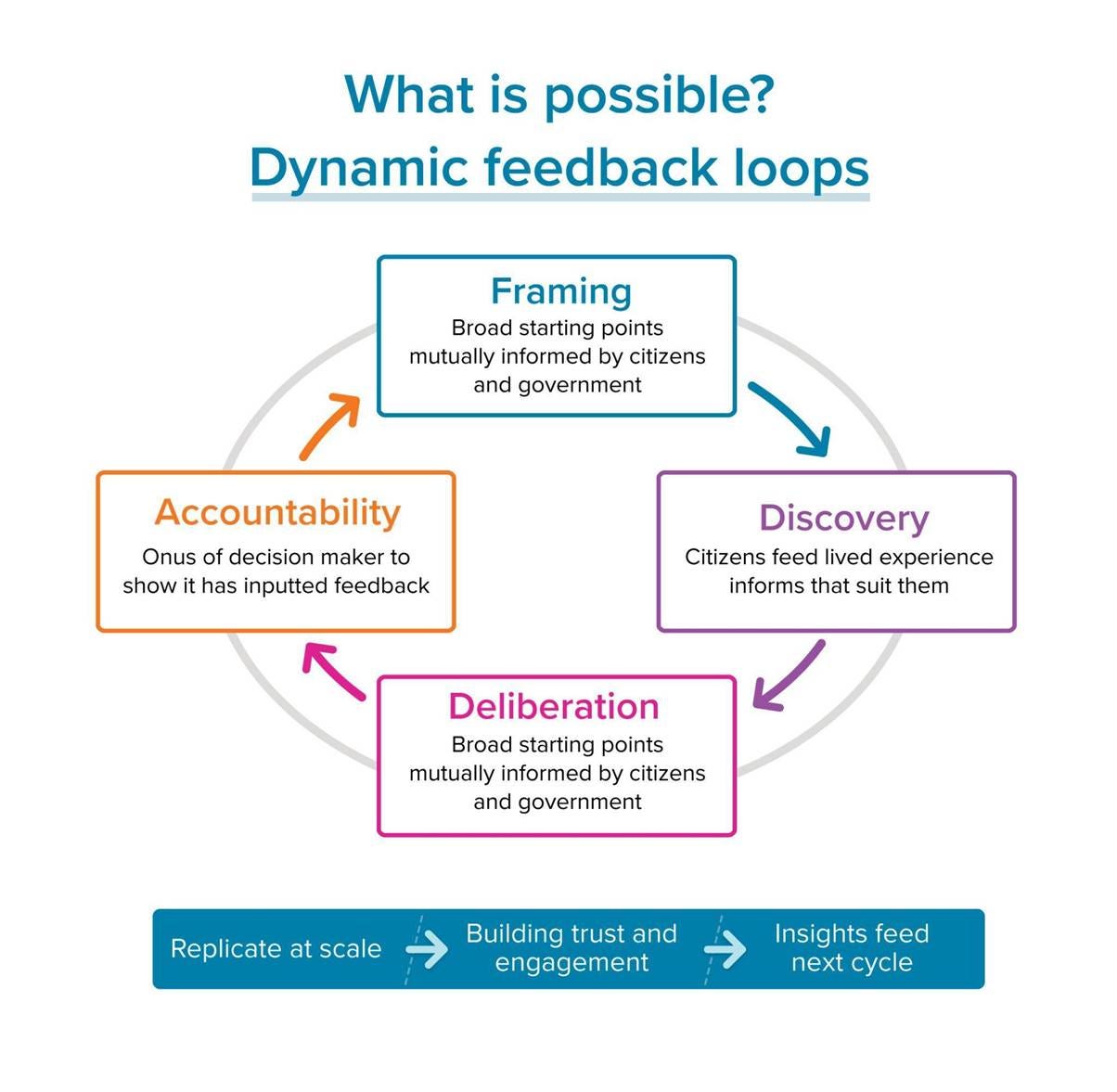
Australia has an opportunity to experiment and build civic infrastructure that strengthens democratic resilience and supports adaptive, digitally enabled dynamic feedback loops between government, community and civil society.
Context
Traditional forms of civic participation are declining, and formal government consultation processes often do not meet community or individual expectations. At the same time, digital platforms are increasingly preferred arenas for public engagement, but their current design and use tend to amplify polarisation and grievance rather than constructive dialogue and solution building. Instead of helping societies navigate uncertainty and disagreement toward shared solutions, they often deepen division.
In countries such as Taiwan, France, Germany, Brazil, and Spain, governments and civic innovators are building new public spaces that combine digital and in-person engagement in ways which prioritise inclusion, accountability, and responsiveness. These examples show that, when intentionally designed, digital infrastructure can accelerate and strengthen the feedback loops that connect lived experiences, technical knowledge, and deliberative processes to different democratic decision forums, on a local to national scale.
In Australia, opportunities to experiment are continually emerging, from Disability Dialogues to regional energy transitions to local council engagement to housing planning and how we use AI in schools. These are dialogues where communities and policymakers are jointly asking how to best come together to navigate uncertainty and disagreement, and how to link digital environments and in-person methods to facilitate ongoing, trustworthy participation.
However, Australia still lacks consistent measures of civic participation that capture how people engage, why they participate, and what outcomes they experience. Current monitoring focuses on volunteering rates or social-media activity, rather than how the programs work, the degree of responsiveness, strengthening of belonging, or perceived fairness. Future research and evaluation might measure when and how engagement leads to being heard and the conditions required for forms of engagement which are iterative, adaptive, and solution-focused to strengthen decision-making, the conditions which build resilient democracy and strong civic spaces.
Key Challenges
Shifting participation preferences from in-person to digital spaces.
Mismatch between participation mechanisms and decision contexts.
Difficulty listening and responding at scale and pace.
An Emerging Taxonomy of Digital Engagement
The paper identifies a rough taxonomy of civic infrastructure that links digital tools to stages of feedback and participation:
Static one-way processes – Inform and Consult.
Relies on outreach through existing platforms, from social media to online surveys to government communication channels. These are low-cost and reach broad audiences but offer limited feedback and transparency on information sharing mechanisms.Static two-way processes – Involve and Collaborate.
Tools like Pol.is or Brazil’s parliamentary commenting system allow structured deliberation but still feed into largely top-down decision making processes.Dynamic two-way processes – Collaborate and Empower.
Deliberative and participatory models allow communities to actively lead or co-design processes and adapt policies in real time, integrating lived experience and data through iterative learning. These approaches, often supported by Bayesian learning or rapid-cycle evaluation, are still emerging in public policy but are widely deployed in other private sectors.
Recommendations
1. Embed Democratic Principles into Digital Tools
Large-scale social networks are unlikely to reform themselves, but there is a compelling case to embed democratic principles into the design of tools used for civic engagement:
Inclusive and solution-oriented design: Create processes that enable disagreement without division and focus on shared outcomes.
Accountability: Support community-governed or not-for-profit platforms as public infrastructure alternatives.
Transparency: Promote open-source models and transparent algorithms to ensure traceability and fairness.
Credible information: Guarantee user rights over data use and protection, building on examples such as the Disability Data Trust and First Nations data sovereignty frameworks.
Trustworthy processes: Ensure that any value created from community participation is reinvested back into the community, reinforcing consent and legitimacy.
2. Start Experimenting
There are immediate opportunities for both communities and governments to pilot new engagement models:
Prioritise community-driven solutions informed but not determined by technocratic fixes. Invite citizens to help design feedback tools that reflect their needs and preferences for engaging.
Connect government engagement with community-led models such as the Disability Dialogue.
Create meaningful and responsive feedback loops, not just data collection, using adaptive, evidence-driven methods.
Mobilise resources to develop independent, transparent, and participatory digital infrastructure.
3. Reinforce a Living Evidence Network
Build on existing initiatives create new ‘sandboxes’ to test and evaluate what strengthens dynamic feedback between civic and institutional systems:
Adapt existing surveys to measure how, when, and why people engage, especially online.
Analyse how different engagement designs affect participation, belonging, and trust.
Invest in “listening at scale” methods, including Bayesian learning, to enable adaptive decision-making in councils, communities, and state-level pilots.
4. Connect Communities of Practice
Innovation is already happening across government, academia, and civil society. Networks such as the Municipal Association of Victoria, Centre for Deliberative Democracy, and the Australian Community Managers Association (through its All Things in Moderation conference) are building shared learning environments for moderation, facilitation, and participation. A national Civic Innovation Network could link these efforts, strengthen the evidence base, and help practitioners draw on each other to design inclusive and adaptive civic spaces.
Looking Ahead
Australia’s democratic future depends in part on expanding the ways communities can participate, deliberate, and decide together. Digital tools are part of this story, but only if they are designed with democratic values at their core.
Future RDRDN work could focus on building the evidence base for civic infrastructure that supports trustworthy participation integrating measurement, experimentation, and design principles that help democracy learn at scale. The network continues to seek examples and potential partners in communities and agencies ready or already experimenting.