


Full Paper Citation: Print, M. (2025). Exploring Evidence and Models for Experiential Civic Education Opportunities. Discussion Paper 13. Australian Resilient Democracy Network. Full paper available here
Why does this matter?
Civic learning and confidence depend on knowledge of how democratic institutions function, the values that underpin them, and the roles and responsibilities of citizens and social movements. In Australia, this understanding is declining. The trend is visible both in national assessments of civics knowledge and in surveys that measure people’s confidence in their understanding of democracy.
Building on conceptual framing raised in ARDN Discussion Paper 6 (link) around how civic knowledge impacts our civic life journeys, this explores why after decades of effort to strengthen civics education through school curricula, an important question remains: what else can be done to support civic learning beyond the classroom? In particular, how do hands-on experiences of democracy affect participants over different stages of their lives? What experiences help increase confidence, encourage sustained engagement across the civic life course, or strengthen satisfaction with democracy? Are experiential programs effective ways to engage Australians later in life and in different institutional settings to reinforce civic knowledge after school years?
This post summarises an initial assessment made in a new Discussion Paper for the Australian Resilient Democracy Network by Professor Murray Print, summarising what we know about what is currently happening in Australia.
Key takeaways
Survey evidence consistently links civic knowledge and participation in early life to stronger democratic attitudes and engagement later in life. These dynamics form one of the key strengthening flows for democratic resilience. Yet outcomes in formal civics education have declined, and large gaps remain in how young Australians learn about democracy.
Emerging evidence suggests that experiential civic education, including parliamentary visits, election simulations, deliberative simulations, and site-based learning delivered by schools, government agencies, and community organisations, increases confidence in understanding democratic practices and supports long-term engagement.
Access to these programs in Australia is uneven. Opportunities are limited, inequities are significant, and most programs are rarely evaluated in ways that inform improved design or delivery.
Comparative analysis from the United States shows that most experiential civic education still sits within schools, but there is a growing ecosystem of learning delivered through museums, libraries, cultural institutions, sports clubs, parks, churches, local government, and community organisations.
Context
Sustaining democracy requires more than formal institutions. It depends on each new generation developing civic awareness, practical skills, and confidence to participate through lived experience.
Recent work from the United States-based Ash Center [link] defines civic learning as education that develops civic knowledge, skills, and dispositions through the active practice of democracy, including decision-making, community problem-solving, negotiation, and dispute resolution, whether in real or simulated settings. The emphasis is on putting understanding into action, building skills through participation, and developing civic virtues through reflection. Civic learning programs can serve different purposes, from understanding government processes, reinforcing common values to building skills for dialogue and responsible engagement.
Experiential civics takes many forms across our civic life journey [see ADRN Discussion Paper 6], including structured discussions, simulations, project-based learning, community service, school governance, civic campaigns, extracurricular programs such as debating, youth-led initiatives, and site visits.
Print (2025) focuses on what we know about experiential civic education for school-aged children, what we need to know, and how we can support existing offerings to support the next generation of student’s confidence and knowledge of our democracy to make it more resilient. Using the following model, the paper starts to assess if expanding and effectively monitoring experiential civic education.
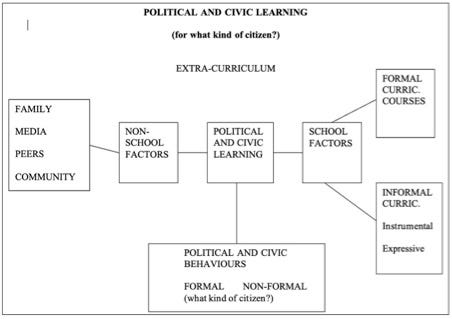
What the Australian evidence tells us
The National Assessment Program for Civics and Citizenship, currently Australia’s only standardised national measure of civics knowledge, shows a clear decline in students’ understanding of democratic processes. While the assessment has limitations, the overall trend raises serious questions about how civic education is delivered and reinforced.
Survey evidence from the Australian Public Service Commission adds an important insight. More Australians recall experiential civic learning, such as school visits to Parliament, than formal classroom civics lessons. This finding points to a deeper question: how do experiential opportunities shape confidence, understanding, and willingness to engage in democracy over time?
The international research base on experiential civic education remains limited. A recent U.S. report, Experiential Civic Learning for American Democracy, suggests that well-designed experiential programs can strengthen civic learning outcomes for students. However, much of the existing evidence relies on self-reported surveys rather than rigorous longitudinal evaluation, highlighting the need for stronger research.
What currently counts as experiential civic education in Australia?
Experiential civic education differs from classroom learning, even though formal curriculum plays an important role in building democratic resilience. This paper suggests that as a starting point, to qualify as experiential civic education, an opportunity needs to meet four core criteria:
It is offered in a relevant site as a form of situated learning, such as a parliamentary building.
It places learners in realistic or active engagement conditions, such as a courtroom setting.
It uses realistic or simulated formats that actively involve participants, such as voting in a mock election.
It integrates experience with explicit learning of civic knowledge, skills, and values.
Where experiential civic education happens in Australia
In Australia, many experiential opportunities are delivered through government-supported programs linked to schools. Canberra-based institutions, supported by the PACER rebate, include the Parliamentary Education Office, the Australian Electoral Commission, the Museum of Australian Democracy, and the Australian War Memorial. These programs reach large numbers of students each year and provide structured, interactive experiences of democratic processes.
State-based opportunities mirror many of these models. Parliamentary education programs, court-based learning, museums, heritage sites, and environmental education centres offer site-based civic learning across jurisdictions. These programs often emphasise interaction, role-play, and engagement with democratic institutions.
Despite this activity, major gaps remain. Access is uneven, particularly for disadvantaged and regional and remote schools. Program costs often exceed available rebates. Most importantly, there is little systematic evidence about how these experiences affect students’ knowledge, attitudes, or civic participation over time.
Beyond schools
Experiential civic education also occurs outside formal education. School camps, volunteering programs, cadets, youth leadership initiatives, community organisations, sporting clubs, and cultural institutions all provide experiences that build civic skills and values, often indirectly.
These activities contribute to social capital and democratic health by fostering cooperation, trust, responsibility, and collective decision-making. Yet they are rarely recognised or evaluated as part of Australia’s civic education ecosystem.
Viewing civic participation as a life-long journey helps broaden our understanding of where and when democratic learning occurs. It shifts attention from single interventions to cumulative experiences across the life course.
What we need to know
To strengthen experiential civic education in Australia, several knowledge gaps need to be addressed:
Participation and access
Who currently participates in experiential civic education, and who misses out? Where do inequities exist across geography, socio-economic status, and education pathways?Timing and delivery
When are experiential opportunities most effective, and which pedagogical approaches deliver the strongest learning outcomes?Links to curriculum
What are the effective approaches to design experiential learning programs, and how can they be adapted to reinforce formal civics education in Australian schools and communities?Impact across the civic life course
What short- and long-term effects do experiential programs have on knowledge, trust, participation, and democratic resilience?Post-school opportunities
How do civic experiences shape engagement and confidence beyond the school years?Roles of government and civil society
How can public institutions, community organisations, employers, and cultural institutions expand access and improve quality?
Emerging questions
New technologies raise further questions for experiential civic education:
How does experiential learning interact with digital civic life?
Can AI-based simulations meaningfully replicate experiential civic education, and how do they compare with in-person experiences?
How do educators respond to digitally mediated civic learning?
How does social media, as a source of experiential civic learning, shape trust and democratic resilience?
What roles can local councils, employers, and cultural institutions play in extending civic education to older generations?
What comes next
Strengthening experiential civic education offers a practical pathway to building democratic knowledge, confidence, and long-term engagement. Doing so will require clearer definitions, better mapping of existing programs, stronger evaluation, and collaboration across government, schools, and civil society.
There are opportunities for national cultural institutions, sporting clubs, and networks of non-profit organisations to incorporate experiential civic education modules into their existing programs and engagement. Strengthening youth-led initiatives also presents significant potential. To maximise impact, we recommend conducting rapid evaluations and share the findings in collaborative efforts to identify which approaches most effectively foster civic awareness, build confidence, and promote life-long engagement in democratic life.
There is also an immediate opportunity to bring together civil society organisations and government service providers to deliver evaluation training focused on identifying civic education, knowledge, and behaviours as part of program assessments. This approach could reveal significant evidence of programs already underway in Australia that could be further strengthened and connected.
This paper argues for a coordinated national effort to understand what works, who benefits, and how experiential civic education can support democratic resilience across Australia’s civic life course.